
Summary
Weiquanwang reported on 6 April 2011 that Wen Tao, a former reporter for the English edition of the Global Times, was forced into a car by plainclothes men outside the home of Wen's girlfriend in Beijing's Chaoyang district on 3 April 2011, the day artist Ai Weiwei was taken away, and that nothing had been heard of Wen for about 70 hours. Chinese Human Rights Defenders' list of people affected by the 2011 crackdown records Wen as released by 27 June 2011.
Timeline
Listed as an enforced-disappearance case
Chinese Human Rights Defenders' list of those affected by the crackdown that followed the call for a "Jasmine Revolution" records Wen as an enforced-disappearance case, missing since 3 April.
Chinese Human Rights Defenders
Individuals Affected by Crackdown on Civil Society Following Call for "Jasmine Revolution"
Open original source (opens in a new tab)Taken away by plainclothes men
Weiquanwang said that at about 2 p.m. on 3 April 2011 Wen was forced into a car by several plainclothes men outside the home of Wen's girlfriend in Chaoyang district, and that nothing was heard of Wen afterwards. At the time of writing Wen had been missing for 70 hours.
Weiquanwang
Weiquanwang: Ai Weiwei and Wen Tao taken away by police, no word for three days
Open original source (opens in a new tab)
Sources
This page consolidates publicly available external sources. Links open the original publication.
External source
Weiquanwang
Weiquanwang: Ai Weiwei and Wen Tao taken away by police, no word for three days
Open original source (opens in a new tab)External source
Chinese Human Rights Defenders
Individuals Affected by Crackdown on Civil Society Following Call for "Jasmine Revolution"
Open original source (opens in a new tab)Cases on similar issues
Chen Qiushi陳秋實
lawyer and citizen journalist · Mainland ChinaCHR-878610
Chen Qiushi, who worked as a lawyer, reported on the 2019 Hong Kong protests and, in January 2020, on the coronavirus outbreak in Wuhan. Human Rights Watch says Wuhan authorities took him into custody on 7 February 2020 and that by 27 April 2020 he had not been heard from. In September 2020 his friend Xu Xiaodong said prosecutors had decided not to prosecute him, and Central News Agency, citing Radio Television Hong Kong, reported in October that he was on bail pending trial and living with his family in Qingdao while still under residential surveillance. Voice of America reported that he reappeared on 30 September 2021 on Xu's YouTube live stream, and in an interview published by Mirror Media in June 2022 he said Shandong national security officers had brought him back to Qingdao after he tried to leave.
· Mirror Media
Cheung Chi-ping張志平
a business manager of Causeway Bay Books · Hong Kong · Mainland ChinaCHR-766529
According to a Human Rights Watch statement of 10 February 2016, Cheung Chi-ping, a business manager of Causeway Bay Books, had been missing since mid-October 2015 and was believed to have been in Shenzhen or Dongguan. Hong Kong authorities were told on 4 February 2016 that mainland authorities had imposed criminal compulsory measures, without disclosing the place of detention. Human Rights Watch described the withholding of his whereabouts as an enforced disappearance.
· Human Rights Watch
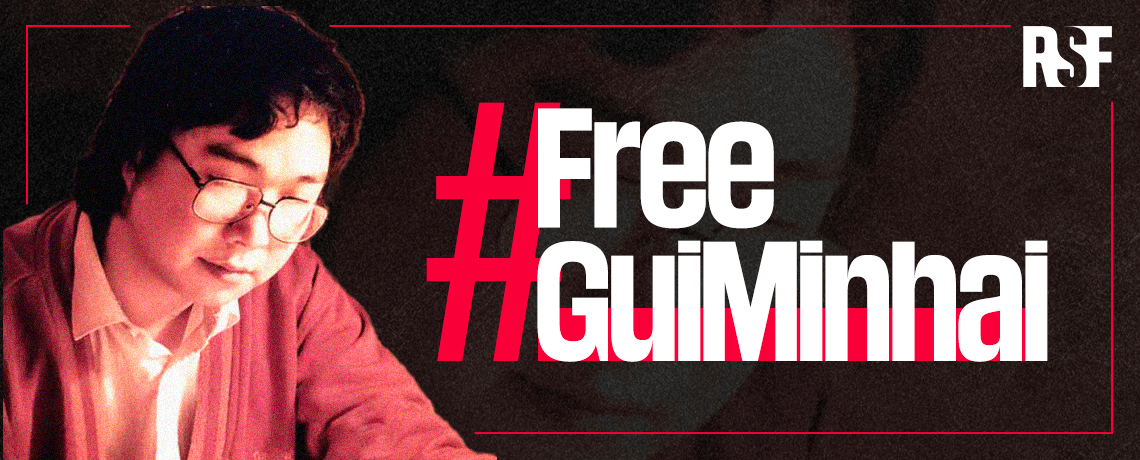
Gui Minhai桂民海
Publisher · Mainland ChinaCHR-945070
Gui Minhai, a Swedish publisher and co-founder of Mighty Current known for investigating Chinese politics, was sentenced on 24 February 2020 to ten years for illegally providing intelligence abroad, charges Reporters Without Borders calls fabricated. RSF said in February 2025 that there had been no news of his whereabouts for five years and described him as forcibly disappeared. He was allegedly abducted by Chinese agents in Thailand in 2015 and rearrested in 2018.
· Reporters Without Borders (RSF)
Events on the same issues
Persecution
Citizen journalists detained after reporting from Wuhan; others sentenced for providing state secrets or intelligence abroad
Bitter Winter reported that three self-described citizen journalists, Fang Bin, Chen Qiushi and Li Zehua, were detained one after another by the authorities after reporting from Wuhan on the epidemic. It also reported that since the authorities designated it a "hostile overseas website" in summer 2018, at least 45 of its reporters and contributors have been detained on grounds such as "leaking state secrets". It cites earlier cases: on 24 February 2020 a Ningbo court announced a ten-year sentence for Gui Minhai, a shareholder of the Causeway Bay Books, for "illegally providing intelligence abroad"; in July 2019 Huang Qi was sentenced to 12 years for "illegally providing state secrets abroad"; and in 2015 journalist Gao Yu was sentenced to five years for leaking a Party document.
Persecution
BBC reports satellite images and testimony on Xinjiang detention camps, including one at Dabancheng
The BBC reported on 24 October 2018 that a satellite image taken on 22 April 2018 showed a large, heavily guarded compound in the desert outside Dabancheng, near Urumqi, with an outer wall about two kilometres long and 16 watchtowers. The BBC says China is accused of holding hundreds of thousands of Muslims in Xinjiang without trial; the Chinese government denies this and says people attend voluntary "vocational schools" to combat "terrorism and religious extremism". According to the BBC, German scholar Adrian Zenz found Xinjiang government tender documents describing dozens of camps with watchtowers, barbed wire and guard rooms, and an Australian architecture firm's most conservative estimate was that the Dabancheng site could hold about 11,000 people. The BBC interviewed eight Uyghurs abroad whose accounts of detention it describes as consistent.
Persecution
Uyghurs abroad describe relatives who disappeared or died in Xinjiang camps
Bitter Winter reported on 4 September 2020 on Uyghurs abroad who gathered outside the Chinese embassy in London on 30 August, the International Day of the Disappeared, to speak about relatives missing in Xinjiang. The article says a Turkish television report that week showed that the uncles and cousins of Dilnaz, a teenager, are held in a Chinese prison; her father died in tears after learning they had been sentenced to five to 15 years. It says the Chinese consulate had recently contacted London MPs about her relatives, said to be living normal, happy lives, which a relative in Istanbul called a lie. Salman Uyghur, who lives in Turkey, said his brother Amatjan Sayim, 43, died in a re-education camp in May 2018, Amatjan's wife Patigul was sentenced to 14 years after his death and their five children sent to a state orphanage, and his sister Tursungul Sayim, 41, is also held in a camp.
Reports on similar issues
Source record · Human Rights Watch
World Report 2021: China
Human Rights Watch's China chapter of World Report 2021 covers events of 2020. The report finds that the Chinese government's authoritarianism was on full display as it handled the Covid-19 outbreak, Beijing imposed the National Security Law on Hong Kong on 30 June, and Turkic Muslims in Xinjiang continued to face arbitrary detention, forced labor and mass surveillance, controls on Tibet, religion, the internet and rights defenders tightened, and international concern grew.
Source record · Human Rights Watch
World Report 2022: China
Human Rights Watch's China chapter of World Report 2022 covers events of 2021. The report finds that under Xi Jinping the Chinese government doubled down on repression inside and outside the country, using its zero-tolerance Covid-19 policy to strengthen its hand, and authorities devastated rights in Hong Kong. The report adds that the government is committing crimes against humanity against Uyghurs and other Turkic Muslims, Tibetans face grave abuses, and space for women's and LGBT rights shrank.
Source record · Congressional-Executive Commission on China (CECC)
Congressional-Executive Commission on China: 2025 Annual Report
The Congressional-Executive Commission on China's 2025 Annual Report covers 1 July 2024 to 30 June 2025 under the theme "promises made, promises broken": the gap between the PRC's treaty and legal commitments and its practice. Its 17 chapters document restrictions on expression and religion, arbitrary detention, Xinjiang, Tibet, Hong Kong and transnational repression. Its Political Prisoner Database held 11,262 records on 30 June 2025, 2,755 of them active detentions.