
Summary
Human Rights Watch's China chapter of World Report 2021 covers events of 2020. The report finds that the Chinese government's authoritarianism was on full display as it handled the Covid-19 outbreak, Beijing imposed the National Security Law on Hong Kong on 30 June, and Turkic Muslims in Xinjiang continued to face arbitrary detention, forced labor and mass surveillance, controls on Tibet, religion, the internet and rights defenders tightened, and international concern grew.
What the report says
The report says the Chinese government's authoritarianism was on full display in 2020 as it grappled with the coronavirus outbreak first reported in Wuhan. Authorities initially covered up news about the virus, adopted harsh quarantine measures, rejected international calls for independent investigations, and surveilled and harassed families of those who died. Beijing's repression, which insists on political loyalty to the Communist Party, deepened across the country, including in Hong Kong, Xinjiang and Inner Mongolia, where protests broke out in September over replacing Mongolian with Mandarin in some classes. Ren Zhiqiang received an 18-year sentence in September after calling Xi Jinping "a clown who desires power", while Cai Xia, who called the Party a "political zombie", fled into exile.
On Hong Kong, the report says the Chinese government replaced its top Hong Kong official with Luo Huining in January and, on 30 June, bypassed the Legislative Council to impose a National Security Law, its most aggressive assault on Hong Kong people's freedoms since 1997. The law creates specialized secret security agencies, denies fair trial rights, gives the police sweeping new powers and weakens judicial oversight. Jimmy Lai, Lee Cheuk-yan and Yeung Sum were arrested in February, 15 pro-democracy leaders including Martin Lee in April, and Lai again in August after a raid on Apple Daily. A dozen pro-democracy figures were disqualified from the September election, which was postponed by a year; Benny Tai was sacked; and press freedom was restricted at RTHK and on journalists' visas.
On Xinjiang, the report says the government's efforts to erase the identity of Uyghurs and other Turkic Muslims persisted. It cites a January CNN investigation concluding that more than 100 traditional Uyghur cemeteries had been destroyed, and an August BuzzFeed study of satellite imagery showing that authorities had built over 260 "massive" detention structures since 2017. The report adds that an untold number of Turkic Muslims remain detained, some released detainees are forced to work in factories and fields, and an Australian think tank listed 82 global brands sourcing from such factories. On Tibet, the report says authorities severely restrict religion, speech, movement and assembly, regulations on "Nationality Unity Model Areas" took effect in May, and Xi called at the 7th Forum on Tibet Work in August for more political education in schools.
The report's Covid-19 section says the response was initially delayed by withholding information, under-reporting cases and dismissing human-to-human transmission, and authorities detained people for "rumor-mongering". Lockdowns in Wuhan and in Xinjiang in August left residents without proper access to medical care and food, and in Guangzhou authorities forcibly tested Africans and ordered them into quarantine. On human rights defenders, authorities detained Chen Qiushi, Fang Bin and Zhang Zhan for reporting on Wuhan, and Chen Mei and Cai Wei for archiving censored articles. Pastor Wang Yi received a nine-year sentence, Xu Zhiyong was seized in February, Wang Zang and Wang Liqin were forcibly disappeared, Wang Quanzhang was released in April, and Yu Wensheng received a four-year sentence in June.
On freedom of expression, the report says authorities detained and prosecuted netizens for online posts and chat messages on charges such as "spreading rumors", "picking quarrels" and "insulting the country's leaders", and a Cyberspace Administration set of rules in March banned a widening range of "negative" content. Authorities shut down Bainu, the only Mongolian-language social media site in China, in August, and a Ningbo court sentenced Swedish bookseller Gui Minhai to 10 years in March. On religion, the Administrative Measures for Religious Groups took effect on 1 February and declare the supremacy of the Party in religious affairs, and pastor Zhao Huaiguo of Bethel Church in Cili County, Hunan, was arrested on 2 April. The report also covers Health Code surveillance apps and the September detention of publisher Geng Xiaonan.
The report's sections on women, LGBT people and disability say domestic violence cases surged under lockdowns, and the civil code introduced in June for the first time defines sexual harassment but imposes a 30-day mandatory "cooling-off period" on divorce by agreement, which it says will disproportionately harm women. Shanghai Pride announced in August that it would cancel all activities indefinitely and China lacks laws against discrimination on the basis of sexual orientation or gender identity. On disability, only five students could access the Braille version of the university entrance exam, and a Hunan court secretly tried Cheng Yuan, Liu Dazhi and Wu Gejianxiong of Changsha Funeng on "subversion" charges in September. On refugees, China continued to detain and forcibly return North Koreans.
On key international actors, the report says an increasing number of governments voiced public concern about China's rights record in 2020, particularly on Hong Kong and Xinjiang, though relatively few took concrete action. The US sanctioned top Chinese officials responsible for Xinjiang abuses in July, and in June 50 UN special procedure mandate-holders called for a special session of the Human Rights Council on China. Germany delivered a joint statement backed by 39 countries at the UN General Assembly's Third Committee in October, and China was elected to the Human Rights Council with the fewest votes of any elected member. Beijing also expelled Wall Street Journal and other US media journalists, and Australian anchor Cheng Lei was detained in August.
Key findings
China elected to the UN Human Rights Council with the fewest votes
China was elected for a three-year term beginning in January 2021 with the fewest votes of any elected member.
Ren Zhiqiang sentenced to 18 years
The entrepreneur, who wrote an essay calling Xi Jinping "a clown who desires power", received what the report calls an extraordinarily lengthy sentence.
Hunan court secretly tries Changsha Funeng staff
Cheng Yuan, Liu Dazhi and Wu Gejianxiong were tried on "subversion" charges.
Jimmy Lai arrested after raid on Apple Daily
Police raided the newspaper's office and arrested Lai, his two sons and four executives for "collusion with foreign forces" and conspiracy to commit fraud.
Satellite study finds over 260 detention structures in Xinjiang
A BuzzFeed study found that Xinjiang authorities had built over 260 "massive" detention structures since 2017, supporting earlier findings of mass arbitrary detention of Turkic Muslims.
US sanctions top Chinese officials over Xinjiang
The report says the US government sanctioned top Chinese officials responsible for Xinjiang abuses.
National Security Law imposed on Hong Kong
The Chinese government bypassed the Legislative Council to impose the law, which the report calls its most aggressive assault on Hong Kong people's freedoms since 1997.
Yu Wensheng sentenced to four years
A Jiangsu court convicted the human rights lawyer, detained since January 2018, of "inciting subversion".
Wang Quanzhang released after four and a half years
The human rights lawyer was released from prison in April but was made to quarantine in his hometown before rejoining his family in Beijing under guard.
Gui Minhai sentenced to 10 years
A Ningbo court sentenced the Swedish bookseller for allegedly "providing intelligence" to foreigners, five years after he was forcibly disappeared in Thailand.
Administrative Measures for Religious Groups take effect
The measures declare the supremacy of the Communist Party in religious affairs and prohibit religious groups from operating without authorization.
Beijing replaces its top Hong Kong official with Luo Huining
The report says the Chinese government replaced its top Hong Kong official with Luo Huining, who had no Hong Kong experience but was known as a Communist Party enforcer.
CNN finds over 100 Uyghur cemeteries destroyed
A CNN investigation using satellite imagery concluded that over 100 traditional Uyghur cemeteries had been destroyed.
Source record
Human Rights Watch
This page is a summary. The original was published by the organization named above.
View original report (opens in a new tab)People named in this record
Chen Qiushi陳秋實
lawyer and citizen journalist · Mainland ChinaCHR-878610
Chen Qiushi, who worked as a lawyer, reported on the 2019 Hong Kong protests and, in January 2020, on the coronavirus outbreak in Wuhan. Human Rights Watch says Wuhan authorities took him into custody on 7 February 2020 and that by 27 April 2020 he had not been heard from. In September 2020 his friend Xu Xiaodong said prosecutors had decided not to prosecute him, and Central News Agency, citing Radio Television Hong Kong, reported in October that he was on bail pending trial and living with his family in Qingdao while still under residential surveillance. Voice of America reported that he reappeared on 30 September 2021 on Xu's YouTube live stream, and in an interview published by Mirror Media in June 2022 he said Shandong national security officers had brought him back to Qingdao after he tried to leave.
· Mirror Media
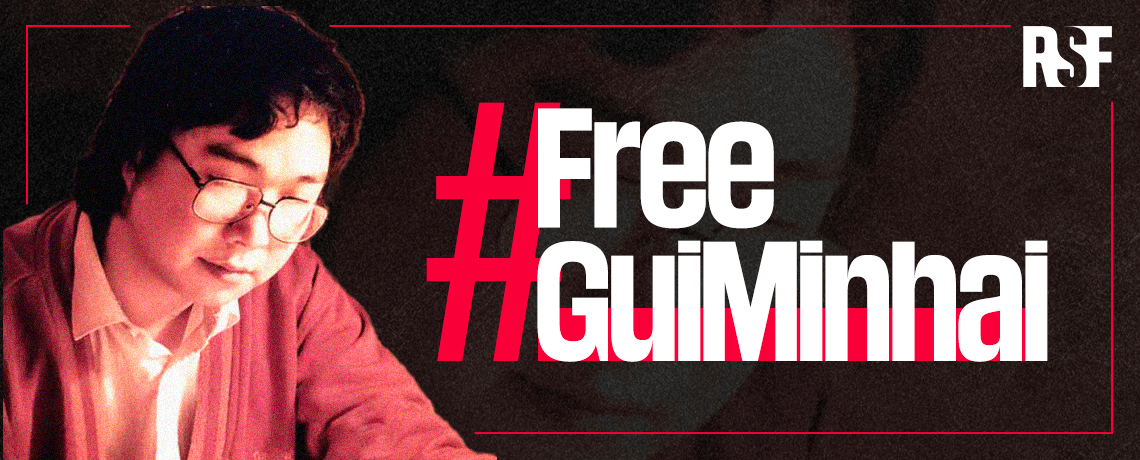
Gui Minhai桂民海
Publisher · Mainland ChinaCHR-945070
Gui Minhai, a Swedish publisher and co-founder of Mighty Current known for investigating Chinese politics, was sentenced on 24 February 2020 to ten years for illegally providing intelligence abroad, charges Reporters Without Borders calls fabricated. RSF said in February 2025 that there had been no news of his whereabouts for five years and described him as forcibly disappeared. He was allegedly abducted by Chinese agents in Thailand in 2015 and rearrested in 2018.
· Reporters Without Borders (RSF)
Wang Quanzhang王全璋
Human rights lawyer · Mainland ChinaCHR-158281
Wang Quanzhang is a human rights lawyer. A joint statement published by Human Rights Watch says police detained him on 3 August 2015. He was held incommunicado for more than three years, tried behind closed doors on 26 December 2018, and sentenced in January 2019 to four years and six months for "subversion of state power." He was released on 5 April 2020. In a BBC interview published on 9 July 2025, he said his family in Beijing was still closely watched.
· BBC Chinese
Reports that name the same person
Source record · Human Rights Watch
World Report 2022: China
Human Rights Watch's China chapter of World Report 2022 covers events of 2021. The report finds that under Xi Jinping the Chinese government doubled down on repression inside and outside the country, using its zero-tolerance Covid-19 policy to strengthen its hand, and authorities devastated rights in Hong Kong. The report adds that the government is committing crimes against humanity against Uyghurs and other Turkic Muslims, Tibetans face grave abuses, and space for women's and LGBT rights shrank.
Source record · Human Rights Watch
World Report 2023: China
Human Rights Watch's China chapter of World Report 2023 covers events of 2022. The report finds that repression deepened as Xi Jinping secured an unprecedented third term as Communist Party general secretary, and repeated Covid-19 lockdowns on hundreds of millions of people led to deaths and hardship. Assaults on rights continued in Hong Kong, Xinjiang and Tibet, and the UN human rights chief's August Xinjiang report concluded that abuses "may amount to crimes against humanity".
Source record · Congressional-Executive Commission on China (CECC)
Congressional-Executive Commission on China: 2025 Annual Report
The Congressional-Executive Commission on China's 2025 Annual Report covers 1 July 2024 to 30 June 2025 under the theme "promises made, promises broken": the gap between the PRC's treaty and legal commitments and its practice. Its 17 chapters document restrictions on expression and religion, arbitrary detention, Xinjiang, Tibet, Hong Kong and transnational repression. Its Political Prisoner Database held 11,262 records on 30 June 2025, 2,755 of them active detentions.